| Home Office, Inspiration
Modern Home Office Ideas That Boost Productivity
If you’re hoping to boost your productivity while working remotely, our home office ideas might be the inspiration you need to successfully overhaul your office.
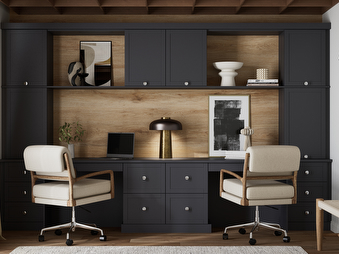
Updating your office is a great opportunity to learn about the benefits of fitted office furniture and when it’s the best choice for your space.
In general, fitted furniture is ideal for long-term office spaces, while freestanding furniture is more often used in mobile offices where more flexibility is needed.
Remote workers and homeowners sometimes find it difficult to decide between fitted and freestanding furniture for a few reasons. The primary concerns are flexibility and budget versus long-term durability, clutter reduction and space efficiency.
Fitted furniture is often more durable than freestanding furniture and supports defined office layouts where little change is expected or desired. Freestanding home office furniture, on the other hand, is often cheaper than fitted furniture and makes it easy to change up room layouts as the need arises.
Let’s take a closer look at the benefits of fitted office furniture and why it’s often the best choice for your home.
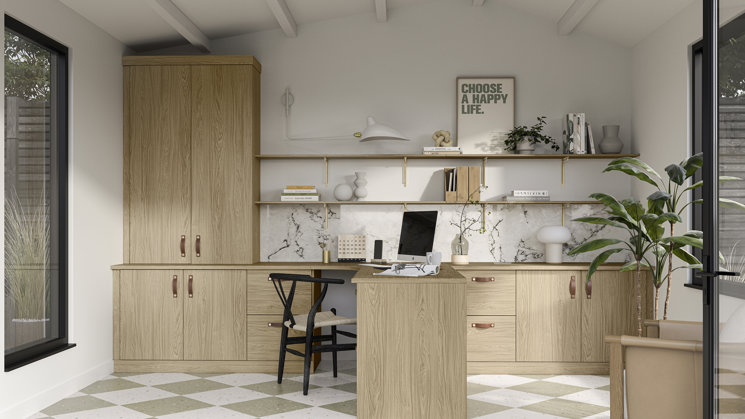
|
Feature/Metric |
Fitted Home Office Furniture |
Freestanding Office Furniture |
|
Space Optimisation |
Custom-built to work around specific room layouts, offering exceptional space optimisation. |
Individual pieces of furniture placed wherever they fit, often with gaps and wasted space between pieces. |
|
Storage Capacity |
Expanded storage options such as built-in closets, filing cabinets and drawers, often spanning from floor to ceiling. |
Storage is limited due to the space limitations posed by multiple freestanding pieces of furniture. |
|
Cable Management |
Built-in cable management, often hidden out of sight for a tidy office. |
Cable management takes place wherever there is room, often out in the open. |
|
Ergonomics & Tailoring |
Designed for specific rooms and homeowners, customisable to suit personal preferences and layout challenges. |
Must work around awkward layouts and is placed in random locations, with limited personalisation options. |
|
Flexibility & Portability |
Fitted in place and not easily movable. |
Able to be freely moved around the office. |
|
Impact on Home Value |
Increases home value for buyers in need of an optimised office space. |
Increases home value for buyers looking for a blank slate. |
Before we look at which kind of office furniture is ideal for home offices, let’s discuss what defines each of them.
Freestanding furniture refers to items of furniture that are not connected to each other or to a wall. If your office contains a desk and bookcases or filing cabinets you can move around, you are using freestanding furniture. Notably, opting for freestanding furniture enables you to mix and match pieces as your budget allows, making it an attractive choice for some buyers.
Fitted office furniture is a bit different. You anchor the pieces directly to the walls and floors of the room, and sometimes also to each other. It’s a bespoke solution that makes bridging uneven floors, skirting boards and irregular wall angles possible. This makes it easier to create a uniform space even in rooms with awkward layouts.
When deciding on fitted home office vs freestanding home office furniture, consider some of the factors we highlighted above. Keep in mind that not every space is suited to fitted furniture, and sometimes freestanding furniture is also not the best choice for a given room. Homeowners with permanent offices, for example, often opt for fitted furniture as individual pieces are not likely to be moved on a day-to-day basis.
Offices requiring a bit more flexibility, such as impromptu or interim home offices where layouts are subject to change, on the other hand, often find that freestanding furniture is the best fit.
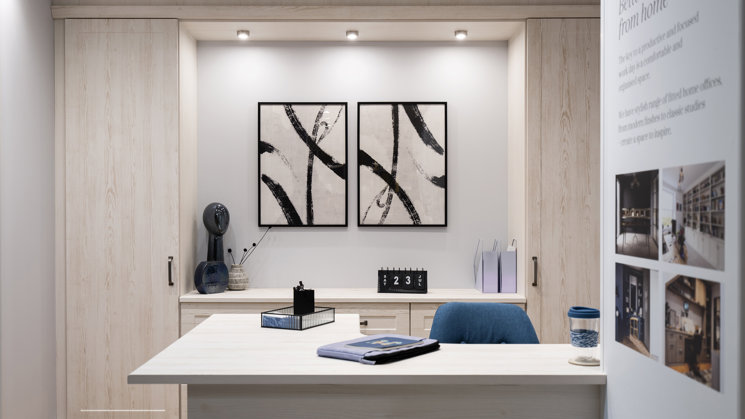
For permanent hybrid and remote workers, your setup should feel like a permanent workstation, not a temporary solution. Fitted office furniture helps create a professional space that supports working from home.
Not every room is a perfect square. In fact, many rooms have unique architectural touches that impact space optimisation, such as shallow alcoves, sloping eaves in loft conversions, and under-window spaces. These spaces are often difficult to work with when designing a home office, and the wasted areas they create are known as “dead zones”.
Fitted home office furniture naturally fills those spaces with bespoke custom cabinetry that works with your space. It also helps prevent the gaps flat-pack desks leave behind, reducing long-term dust build-up.
A cluttered office can impact more than your ability to quickly find specific items throughout the day. It can actually impact your productivity and mood. Research has found that visible clutter creates “cognitive noise”, which is cognitive interference that prevents you from fully focusing on your work.
When your brain has multiple things vying for its attention, it struggles to maintain focus and can lead to workday cognitive fatigue. If you’ve ever sat down and felt exhausted before even beginning your day, a cluttered office might be part of the reason.
Floor-to-ceiling fitted cupboards are a good solution to help reduce cognitive fatigue for many remote workers. They effortlessly hide clutter during the workday, making it easier to concentrate on the task at hand. Multi-device charging hubs behind sleek push-to-open or soft-close doors make staying organised not just pleasant, but also simple.
Long working hours affect not only your cognitive abilities, but also your physical health. Poorly designed furniture can increase hand and arm fatigue from typing, which can lead to serious complications later in life, not to mention daily pain during your workday. Fitted office furniture can be designed around your specific needs and measurements.
If you require a desk that is a bit wider than usual, for example, we can design your office furniture with that in mind. Fitted worktops can also be designed for optimal depth (70- 80 cm), which is ideal for multi-monitor arms, separate keyboards and peripherals without cramping forearm rest.
In addition to workspace size, fitted furniture also often features integrated desktop grommets, internal cable ducting, and power routing that helps keep heavy hardware plugged in without visible wires. All of this supports healthier work habits and enhanced focus by reducing visible clutter.
One of the most overlooked fitted home office benefits is increased home value. A professional fitted home office signals to buyers that the home is move-in ready for remote workers. The high-spec work zone turns an unloved spare room into a high-value asset. And while not all buyers need a home office, remote work is becoming more common every day.
Many buyers like to “future-proof” their home to meet not just their immediate needs, but also their future needs. Fitted home offices are tempting additions to almost any home.
|
“The real value of a fitted home office isn't just the furniture, it's the time and convenience it gives back. A dedicated, organised workspace allows homeowners, parents and professionals to move seamlessly between home and work without sacrificing the kitchen table or dining room every day. With everything designed around the individual and the space available, productivity, focus and work-life balance can all improve.”
Thomas Hefford, West Midlands Divisional Manager & Former Designer |
While fitted home offices suit many workers, freestanding, or modular, furniture can be the best home office option for two main reasons: frequent room layout changes and budget constraints.
Freestanding furniture makes it easy to change a room’s layout at a moment’s notice, potentially allowing homeowners to temporarily make their office into a spare room or guest bedroom as needed. Fitted furniture can’t be easily removed, making the room in question a permanent office with little flexibility.
Immediate budget constraints also impact the decision to use freestanding home office furniture. Fitted home offices require more money up front, while freestanding furniture can be picked up piece by piece as homeowners find deals that fit their budget. In these instances, lower initial capital expenditure takes priority over custom design and longevity.
It’s important to keep in mind that while freestanding furniture has its benefits, it often compromises on storage volume, clean aesthetics and cable tidiness.
With all of the above information in mind, you might be wondering which home office furniture option is the right one for you. There are a few things to consider before you make your choice. First, fitted furniture offers a well-designed and permanent office area that maximises space and storage. The downside is that it can’t be moved.
Modular furniture is easily moved and can be mixed and matched on a budget, but it often relies on standardised module widths that can’t match precise wall dimensions that account for bowing walls or sloping ceilings. It wastes space that could otherwise serve as storage.
For seamless, flush finishes that last, bespoke fitted cabinetry is often the superior long-term investment for serious hybrid and remote workers.
Here are a few things that might impact your decision regarding fitted vs freestanding office furniture.
Choose fitted if you:
Choose freestanding if you:
Now that you have a handle on fitted vs freestanding office furniture benefits, why not explore our collections and book a consultation with our design experts?
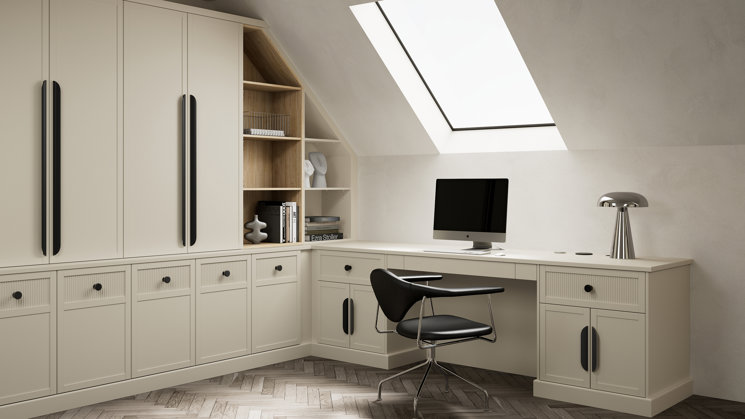
Fitted furniture maximises floor and wall space, even in rooms with awkward layouts. It also conceals hardware and cabling and delivers superior storage tailored to your specific work requirements.
A fitted home office often leads to improved focus and productivity. Custom worktops, built-in monitor depth, and concealed clutter help foster positive work habits and prevent ergonomic strain.
Built-in furniture offers durable materials, integrated power access, and superior structural longevity. It’s much better suited to multi-year daily use than freestanding alternatives.
Whether you have an exact vision in tow, or are just at the beginning stage of your home renovation, we have heaps of inspiration for you to get stuck into.
Find a wealth of design tips, trends and inspiration in the pages of our brochure, magazine and on our blog. Our experts are always ready to help you create dream home, pop in store or book your free design visit for experts to help on bringing your vision to life.